



Latest Issue
 
Windtech International November December 2025 issue
 

Login

 Follow us at BlueSkyFollow us at BlueSky


follow


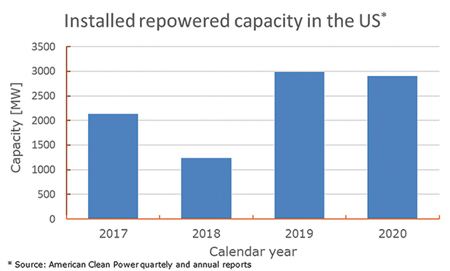
DNV fig 1 Repower capacity chartKey Technical Considerations to Ensure Successful and Sustainable Repowering
In recent years, wind farm repowering has contributed an important fraction of overall US wind farm installations, as developers seek to capitalise on existing infrastructure, proven revenue streams, and tax credit eligibility. Partial repowering, as opposed to full repowering, remains the dominant form in the US market and typically involves reusing the existing foundation and towers, while replacing uptower components with new parts to attain higher performance and financial benefits from the asset. According to the ‘American Clean Power Market Report Fourth Quarter 2020’, partial repowering increased sharply from 2018 to 2019 and remained at roughly 3GW in 2020 (for reference, new US wind installations in 2020 accounted for roughly 17GW).
 
By Ali Ghorashi, Head of Section, Wind Independent Engineering, DNV, USA
 
Key drivers for repowering in the USA include:
⦁ 21GW of onshore wind capacity in North America 10+ years old;
⦁ Production Tax Credit (PTC) extensions along with tax code clarifications for partial repowering;
⦁ improved capacity factor;
⦁ extended operating life;
⦁ reduced opex through renegotiated contracts and newer equipment;
⦁ improved energy sales structure through renegotiated power purchase agreements;
⦁ improved asset value for mergers and acquisitions transactions.
 
DNV fig 2 Upsizing of the rotor diameterTurbine Component Repowering and Risks
The most common partial repowering includes replacement of the nacelle (or drive-train components) and rotor. The main technology risk associated with repowering, as with regular life extension, is the additional fatigue loading on the reused turbine components and foundations. Ultimate loading on reused components may increase or decrease with the repowering and must also be evaluated for suitability. DNV has been involved as independent engineer on nearly 4GW of repowering projects from 2017 to 2020; the majority of repowering projects DNV has been involved with include upsizing of the rotor, resulting in an energy gain of 10–20% but potentially also resulting in additional loads. When assessing turbine suitability for repowering, DNV estimates the accumulated fatigue loading on the original turbine from its operations to date, combined with the expected future loads from the planned operational lifetime for the repowered turbines. Specific attention is paid to the turbine components that will be reused (e.g. towers, nacelle bedplates, or hubs).
 
Load Exceedances
Load exceedances (relative to design) can result in premature fatigue damage; in DNV’s review of site suitability, calculated fatigue load exceedances on towers are not uncommon. In these instances, DNV has often recommended performing visual inspections at a certain point in operations (e.g. 10 years following repowering) to mitigate the risk of serious damage.
 
DNV recommends type certification for the turbine in its repowered configuration to further mitigate site suitability risk. In addition, quality SCADA data from the historical operational period can allow for more accurate and location-specific evaluation of accumulated loading.
 
Assuming repowering installation and post-repowering operation are performed with appropriate due diligence, DNV expects the failure rates for new components (e.g. rotor, nacelle and controls) to be similar to failure rates typical for that of a new-build project with the same base turbine configuration, which can reduce O&M costs and increase availability relative to older turbine models.
 
DNV fig 3 Critical structural checks for foundationsReuse of Turbine Foundations
Almost all repowering projects in the USA reuse the existing foundations, and several items should be considered ahead of such reuse. Wind turbine foundations designed prior to ~ 2010 often do not meet current industry standards, which have evolved over time. On the other hand, modern turbines can be lighter than their predecessors, have more advanced control systems, and may have smaller load failure envelopes for the foundations. Therefore, the repowered configuration may be an improvement from a fatigue loading perspective versus continuing to operate the project under the original configuration, even if the original foundation fails to meet current design standards.
 
Prior to repowering, the condition of the existing foundation and earth should be assessed to ensure that the conditions assumed in the original foundation design have not changed and that the foundation is free of structural deficiencies and in good condition. Cracking or deformation of the soil around the foundation should be investigated, as this can indicate a loss of soil stiffness.
 
DNV fig 4 Original foundation with inadequate top matStructural Risks of Reused Foundations
Certain scenarios can push the foundation closer to, or beyond, its design envelope, including site conditions in excess of design conditions, extreme wind events, emergency stops, not following wind sector management measures, etc. Conversely, if the wind turbine has experienced lighter-than-expected winds over its lifetime, less fatigue loading impact on the foundation would be expected to have accrued over the operating period. A review of the turbine and foundation loading history will shed light on how much load the foundation has experienced since being placed into operation. Similar to turbine suitability analysis, accumulated historical loads plus expected future loads must be considered for the foundations.
 
The illustration in Figure 3 shows critical points for foundation loading. In repowering scenarios, common areas of load exceedance are the pullout steel (#2) and the top and bottom mat reinforcement (#4).
 
Figure 5 RDFoundation Retrofits and Other Mitigants
If the repowering yields loads that exceed the foundation design loading capacity, refurbishment or a retrofit can be designed. Foundation retrofits can be cost prohibitive; therefore, other mitigation measures such as an inspection monitoring programme can be implemented to detect damage at an early stage. This could include monitoring of foundation stiffness, tower frequency measurements, and/or visual observation of cracks. However, such an inspection plan often provides little value to limit the risk of an ultimate strength (i.e. catastrophic) failure due to an extreme event; if ultimate failure is the concern, a retrofit would be needed to bring the foundations into compliance with an acceptable risk level.
 
The illustrations in Figures 4 and 5 demonstrate a typical retrofit (a reinforced concrete collar) for a foundation with inadequate top mat steel loading capacity.
 
Electrical Balance of Plant
The wind project’s electrical balance of plant (EBoP) often does not require upgrades, as long as the original equipment is in good condition, retains an adequate lifespan, and contains a sufficient design margin for any increase in turbine nameplate capacity. Turbine changes that impact EBoP may include nameplate capacity, reactive power capability, generator type, transformer type and impedance, and/or a change from induction to doubly-fed induction generator or full power conversion.
 
Depending on the interconnection agreement terms, turbine type and the repowering technologies and configuration, electrical studies may need to be redone. Similarly, a change in turbine power output may require the grid interconnection studies to be revisited, which may indicate what (if any) changes to the electrical system equipment are required. In DNV experience, project owners have generally avoided changing their interconnection capacity limit, instead choosing to clip their output beyond the interconnection agreement threshold.
 
Environmental Permitting
With regard to environmental considerations, most repowering projects have reduced risk compared with new-build projects. Key issues that should be considered include: impacts to avian species and wildlife; Federal Aviation Administration compliance (particularly if increasing rotor diameter); community acceptance and project constraints; and local, state and federal siting permit requirements.
Financial Considerations

In DNV’s experience, the turbine and installation costs for repowering projects with significant uptower replacements are similar to turbine and installation costs for new construction. Despite the increase in production/revenue and a decrease in opex costs, average offtake pricing in the USA is not sufficient on its own to compensate for the additional capex, and the recent surge in partial repowering is therefore attributed to the eligibility of repowered projects for renewed PTCs. The feasibility of the practice also heavily depends on project specifics, for example the age, technology, contractual arrangements, etc. This may make the practice more appealing for markets with feed-in tariffs and/or higher offtake pricing.
 
Conclusions
Partial repowering can bring higher performance benefits to existing wind assets, with increased annual energy production and higher availability; however, complex loading and operational issues must be adequately evaluated and addressed. Key technology risks in repowered projects typically focus on the foundations and reused wind turbine components; a load assessment should be performed to determine the risk of fatigue load exceedance. Inspection plans or retrofits can help mitigate the risk of fatigue failure, which is a principal consideration for turbines and foundations. The economic benefits of repowering (higher production/revenue and lower O&M costs) are not yet sufficient on their own to make repowering financially viable in the absence of PTCs, high offtake prices, or other incentives; however, continued declines in capex and opex, and an increasing net capacity factor may ultimately enable repowering to be viable without such incentives.
 
Biography of the Author
Ali Ghorashi is the Head of Section, Wind Independent Engineering, at DNV. Ali is an engineering professional with a PhD and MS in Mechanical Engineering from the University of Bath, UK. Prior to becoming Head of Section, Ali held positions as Team Lead, Project Manager and Control Engineer at DNV.
Use of cookies

Windtech International wants to make your visit to our website as pleasant as possible. That is why we place cookies on your computer that remember your preferences. With anonymous information about your site use you also help us to improve the website. Of course we will ask for your permission first. Click Accept to use all functions of the Windtech International website.