

Latest Issue
 
Windtech International November December 2025 issue
 

Login

 Follow us at BlueSkyFollow us at BlueSky


follow


Modelling of the Utsira Wind/Hydrogen Demonstration System in Norway
Image

A wind / hydrogen demonstration project located at the island of Utsira, about 20km off the west coast of Haugesund in Norway, was officially launched by StatoilHydro and Enercon in July 2004. The main objective of this study, part of a joint venture between SgurrEnergy, the University of Strathclyde and the Institute for Energy Technology in Norway, was to evaluate the technical concept being demonstrated, both with respect to system design and operation. The method chosen was to use actual operational data to validate a set of wind/hydrogen-energy system modelling tools using HYDROGEMS and TRNSYS. This article describes how calibrated system models were used in system simulations to identify improved system designs and control regimes. The article also presents the results of the simulations performed to optimise the design of the plant in order to guarantee a 100% stand-alone operation.

By Arnaud Eté, SgurrEnergy, UK .

{access view=!registered}Only logged in users can view the full text of the article.{/access}{access view=registered}

Hydrogen can be used to store intermittent renewable energy, such as solar and wind energy. Remote communities are already experiencing relatively high fuel costs and locally produced renewable hydrogen should be able to compete with traditional fossil fuels sooner than in densely populated areas. Isolated areas with a high wind resource are therefore logical places to site wind/hydrogen systems.

The Utsira Project
The system installed on the island of Utsira, about 20km off the west coast of Norway, is a good example of an autonomous wind/hydrogen system. This island was chosen for its excellent wind conditions and small but representative electrical power demand. The island also provides a great opportunity to test autonomous renewable power systems, as back-up power from the mainland is only available through a subsea cable.

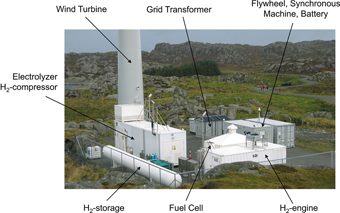
The project started ‘on the ground’ only after several years of concept development, system design and project planning. The project was officially launched by Norsk Hydro (now StatoilHydro) and Enercon in July 2004. The system is still in operation and a significant amount of operational data and experience has been collected since the commissioning of all of the systems during the winter of 2004/05. The autonomous wind/hydrogen system at Utsira (Figure 1), the first of its kind in the world, was designed to meet the entire energy demand for ten households using wind energy only, either directly or indirectly via hydrogen. The objective is to demonstrate how renewable energy and hydrogen systems can provide a safe and efficient power supply to communities in remote areas.

System Description
Two wind turbines, with a rated power output of 600kW, have been installed on Utsira Island, but only one of these is dedicated to the autonomous power system. The other turbine feeds power directly into the local grid. The turbine is connected to the autonomous system via a separate 300kW one-directional inverter. The main components in the hydrogen system are a 10Nm3/h alkaline electrolyser (12bar), an 11Nm3/h hydrogen compressor, and a 2,400Nm3 hydrogen gas storage system (200 bar), as well as a 55kW hydrogen engine generator system. (Nm3 are cubic metres calculated at normal temperature and pressure.) A 10kW PEM fuel cell was also part of the system, but it is currently not in use. The wind power available varies with the wind speed so grid stabilising equipment was required for the autonomous system. It consists of a flywheel (5kWh) for frequency control, a master synchronous machine (100kVA) for voltage control and short circuit power, and a battery (50kWh) for redundancy. The system is designed to provide 2–3 days of full energy autonomy (Figure 2).

Analysis of Operational Data
The system at Utsira has been working properly for the past three years and a significant amount of data from stand-alone operation has been collected. The exception was the fuel cell system, which gave some technical difficulties right from the start. Data from March 2007 shows that 100% stand-alone operation was only achieved about 65% of the time (long-term performance shows stand-alone operation about 50% of the time). The data also shows that during periods of low wind speed the electrolyser frequently needed to operate on grid electricity in order to produce extra hydrogen and level out the storage pressure, which otherwise would have decreased very rapidly. This indicates that the plant is not producing enough hydrogen.

System Simulation
In order to assess the performance of the system and identify any possible improvements to its design, a set of system simulations were performed using calibrated models for the wind turbine, electrolyser system and hydrogen engine. Simulations of the Utsira plant (reference system) and other alternative wind/hydrogen system designs were performed, based on hourly wind speed and power demand measured at the site in March 2007. The system simulations show that it is not possible to achieve 100% stand-alone operation for long periods of time with the existing design. Full autonomy can only be achieved by improving the overall efficiency of the hydrogen production system, by increasing the hydrogen storage size, and/or by increasing the power generating efficiency of the unit, for example by switching from hydrogen engines to fuel cells.

Optimisation of the System
The annual performance of alternative system configurations that would have the potential to reach 100% stand-alone operation was also simulated based on hourly operational data for 2005, and cost-estimated based on general cost parameters. The performance of two optimised system configurations, one based on a fuel cell and the other on a hydrogen engine, were compared. The results show that a system including a fuel cell requires a relatively small electrolyser (10Nm3/h) and hydrogen storage (4,800Nm3) compared to a system with a hydrogen engine, which requires a larger electrolyser (20Nm3/h) and hydrogen storage (11,000Nm3). In summary, the annual simulations confirm that changes in the Utsira system design were required to reach full energy autonomy for long periods of time and show that a wind/hydrogen system based on a fuel cell will be more compact and efficient than a system based on a hydrogen engine (Figure 3).

Conclusion
In conclusion, this study has shown that the system installed at Utsira needs to be modified in order to achieve fully autonomous operation for long periods of time. Increasing the size of the hydrogen storage and replacing the hydrogen engine by a more efficient fuel cell could help in achieving this objective. For the past three years the Utsira system has demonstrated that wind and hydrogen systems can be used to supply power to remote area communities. However, further technical improvements and cost reductions are necessary before wind/hydrogen systems can be viable and compete with existing commercial solutions, for example wind/diesel hybrid power systems. Meanwhile, hybrid system solutions based on more than one energy source (e.g. wind, solar, bioenergy) should be developed to reduce the need for large and costly energy storage. For a hydrogen system based only on wind energy, it is particularly important to choose a location with a steady wind energy resource.

Biography of the Author
After graduating in France, Arnaud Eté studied at the University of Strathclyde in Glasgow where he joined the Energy Systems Research Unit to work on the modelling of hydrogen systems for two years. He is now working as a renewable energy consultant for SgurrEnergy, an independent engineering consultancy specialising in renewable energy.{/access}
Use of cookies

Windtech International wants to make your visit to our website as pleasant as possible. That is why we place cookies on your computer that remember your preferences. With anonymous information about your site use you also help us to improve the website. Of course we will ask for your permission first. Click Accept to use all functions of the Windtech International website.